Unnatural Creatures Review

Another Neil Gaiman book this week. I got put in this reading circle because I caved and told my professor (big Gaiman fan) that I liked the last book we read by him. Rest assured, all of two followers of this blog, my grudge against Gaiman for not adhering to a single audience type remains alive.

This book was not solely by Neil Gaiman, but was a compilation of short stories all centered around a common theme. They all featured as a main element of the story a creature or person who was, in some fashion, unnatural. It was an interesting concept and the stories were well written pieces that ranged from whimsical to haunting.

I enjoyed this collection and would recommend it to teenagers; probably not to younger children because some of the stories contained some innuendos and suggestive comments…nothing explicit but nothing I’d want to explain to a seven or eight year old either. I also don’t know that I’d use it in a classroom setting. There is one story in there I would love to pull out and do an in-depth analysis of with a group of eleventh or twelfth graders. It was called  “The Smile on the Face” by Nalo Hopkinson, and there was this tree that told a girl to be confident and love herself, which is right up my alley and probably the only reason I would like to teach it. I love trees and I love children learning to respect and love themselves for who they are so that’s like a package deal right there.

But anyway. It was a riveting book with stories that pulled me in and had some very original content. This is not a run of the mill scary stories or book of monsters, and it would be an enjoyable read for most ages.

I am Malala Review

Last week we read “I am Malala” and I am just now getting to writing the review because quarantine inspires either an apathy that sinks into the bones and cannot be conquered in a timely matter, or a burning desire to make progress on every creative venture I’ve ever said I do not have the time for. Which fancy overtakes me appears to be directly related to how cold my feet are but I still refuse to wear socks, therefore I have myself alone to blame (as per usual.)

This book is a memoir in which Malala, a girl who was shot by the Taliban for pursuing an education in her native country of Pakistan, tells her life story. The book starts with her birth and goes all the way up to what was present day at the time she wrote it.

This book is admittedly a little slow to get into, mainly because Malala includes so much of the history and politics of her time and region in her memoir that there are large sections of the book that read more like a textbook than a narrative. That said, it explores themes of feminism, equality, and the importance of universal education that are deeply relevant to today’s world, and I think it is a worthwhile book for youths to read. Young girls especially will be inspired by Malala’s story.

Some teaching ideas for this book include literally anything but what I am doing right now…I am currently videoing myself reading this and posting it to canvas for my students, because there is no other way to get hours for my internship. But a book like this, with heavy content and a slow beginning, needs passion to be read well. Students have to want to read it beforehand.

What I would love to do with this is have a group of students that are part of a club, probably a library thing. Women’s history month is in March so during that month I would start by giving them this poem called “For Teenage Girls With Wild Ambition and Trembling Hearts” by Clementine Von Radics, which mentions Malala, Cleopatra, Sacagawea, Joan of Arc, and several other women who influenced history at a young age. After we talked about the poem, I would let them choose a woman from the poem to read a book about and then create a presentation to share with their peers.

I guess this could also be an out of class activity for a normal classroom, I just felt like a club would be great for this because if you join a book club, you generally love books. Also I like libraries.

Wizard of Earthsea Book Review

This week, we read “A Wizard of Earthsea” by Ursula K. Le Guin. This book detailed the origin story of the great mage Sparrowhawk, or Ged, to use his true name. This story is kind of hard to summarize without giving a lot of the plot away, so suffice it to stay it is a beautifully written piece that has elements of high fantasy and the classic coming of age story. The reader follows Ged on a journey of self-discovery as he completes his education as a wizard and battles an unknowable darkness from a surprising source.

The age range for this one is hard to pin down…when I researched the lexile level I came back with a whopping 1150, putting it on par with works like “Frankenstein” that aren’t taught till the eleventh or twelfth grade. Yet something about the book has the undeniable feel of the children’s story. In the end, if a kid of any age (or an adult, for that matter) was interested in the genre, I’d recommend this book. Done with “Narnia” and “The Lord of the Rings”, read all you can handle of the “Dragon Riders of Pern” because I’m not sure if anyone could actually finish that series it’s gotten so big now…this one is next on the list, whether you’re eight or eighty.

If I were to assign this to a class I think our focus would be on theme identification because there’s a lot to unpack here (sorry no spoilers) but there’s also a ton that could be done with mini lessons on imagery and figurative language. These book read almost like poetry and would be a great way to teach descriptive writing!

10/10 would recommend.

Review of Neil Gaiman’s “Odd and the Frost Giants.”


I would like to start out by saying that Neil Gaiman as an author infuriates me to no end by his refusal to pick a category and stick with it.

When I hear the name “Judy Blume” I know what she writes. Stephen King, R.L.Stine, Mary Pope Osborne, same thing. Neil Gaiman? Nope! Is it horror? Fantasy? Sci-fi? Who knows. Not me. (For those smart aleks who want to remark it’s all speculative fiction…please go home. I recognize a difference between stories with dragons, stories with robots, and stories that are scary and it helps me decide what I’m in the mood to read. Leave me and my arbitrary classifications of literature alone.)

He also writes for multiple audiences…one day I’ll be reading his work for a college class and it’s written for a middle schooler, another day my friend’s 12 year old checks out one of his books from a local library and the first scene is sexual. Neil Gaiman is like my cat: bratty, annoying, will not sit in the one box neatly done up for her but must sleep in several boxes not for her around the whole house.

Ranting aside, we read Neil Gaiman’s “Odd and the Frost Giants” for class this week. I found an audio book recorded by the author on YouTube (link here: https://youtu.be/KGIaVwfG8VI) The story followed the adventures of a young boy with a bad leg who sets out to help the Norse Gods Odin, Thor, and Loki to reclaim their home from the Frost Giants and reverse the endless winter that plagues the world as a result of the conquest.

The book was an interesting read with deep themes of the importance of beauty and hummanity. It tied the story up nicely with an unexpected resolution that subverted typical expectations of large battle climaxes. Finally, it had an empowering message about disability not being an insurmountable limitation that was strengthened by the fact that the character is not cured of his ailment at the end of the story: it’s not something that needs to happen for Odd to live a fulfilling life and accomplish his dreams.

I would teach this to almost any grade actually, because of the readily available audio book. In younger grades we’d play it in class and work through it together, and I’d probably use it to help teach plot structure. I like how some of the unconventional plot choices will make it a little less obvious and a bit more challenging when I ask students to identify the elements of the plot. (i.e., the climax is literally just an open and honest conversation)

With older grades I’d normally worry about taking up class time reading a work that doesn’t match the rigor of the state test, but with a video so readily available on YouTube I would not feel bad at all about assigning an entertaining book that they dont even have to actually read as homework. The video is just shy of two hours and I’ll give them a week to do it, making sure my students without access to electronics at home have time to get to a library or school computer or else providing them with a print version (a week is plenty long enough even if they have to read it)

When we get to class, there are SO many routes discussion could take…the presentation of beauty, the introduction of peaceful conflict resolution as an option in a genre flooded with typically violent resolutions as the only option afforded the protagonist, the representation of disability, the depiction of women as powerful/intelligent/human BECAUSE of beauty and not in spite of it, paired with subtle criticism of their treatment as objects to be obtained…the list goes on. We’d probably let discussion go where it would and then take part of class for kids to choose their favorite talking point to develop into an essay. I’d use that to jumpstart a lesson on crafting responses and writing strong coherent paragraphs, then go from there to make those paragraphs become essays over a slightly longer time frame.

I would give this book a glowing recommendation, but again, I hold a personal grudge against the author for fooling me more than once, so I refuse. Thank you and goodnight.

Cinder Review

This week we read “Cinder” by Marissa Myer. A sci-fi retelling of the classic fairy-tale, this Cinderella reboot features a sassy cyborg princess who fixes droids to support her evil stepmother and two step sisters. While doing so, she runs into the handsome prince who needs his old nanny robot fixed so that he can access secret information only she knows. This sets off a chain of events that leads to the discovery of her true identity as a lunar princess

This book was fairly well written and has a lot going for it, including interesting commentary on the damaging nature of societal prejudices and an intriguing subplot dealing with a highly infectious and deadly disease that is a direct result of illegal immigration (big oof)

That said, the plotline is also very predictable and the writing style is not very complex, mainly consisting of action and dialogue. I remember really getting into this book in high school, and rereading it for this assignment was slightly depressing because I realized that I just didn’t like it anymore. It’s fine, really, I’ll just weep for my lost youth.

The lexile level on this book is a 790 which is fairly low, but we just discussing in class how irrelevant and inaccurate lexile levels are, so I’m not sure why we are required to list them in these reviews. I’ll just say that I would put this on a recommended reading list for any middle to high schooler and I would encourage outside projects or essays dealing with the deeper themes that are touched on in the novel. I kind of see it as more of an extracurricular read than a classroom text though.

The Book Thief Stole My Heart

Hello, this is a book review not a love letter, sorry to disappoint. Actually I’m not that sorry.

Let me begin by saying that this book is dear to my heart. It is so original, so lyrical and powerful, that I come back to it again and again, sometimes to just flip through and read a few of my favorite lines. The story is set during World War II and narrated by Death, an overworked but largely sympathetic character rather than the grim reaper we have come to expect. 

Death follows the life of Liesel, a young girl who grows up with a German family that questions the morality of the Nazi platform. Her entire childhood is spent in small-and not so small-rebellions against the party, from stealing books from a burning and learning to read to eventually helping her family to harbor a Jew. Her deep connections and love of people propel the story forward to its inevitable conclusion, another tragedy in the midst of war; the bombing of Hevel street. In spite of her great loss, Liesel lives on, for herself and for the ones that did not. 

Have you read this book? NO? You should read it then. Yes? Why don’t you read it again. You know you want to. Got a paper coming up? Write it on this book. I will read it. Have a child? The lexile level of this book is 730, 4th graders (or precocious third graders) can read it and understand and 12th graders will read it and still cry because it is that good. 

Would I teach this book? No, because I love it too much, and the thought of looking out at my students faces and seeing even one scowling child annoyed at this required reading that they hate breaks my heart. I could not stand it. If I did a unit on Anne Frank, however, it would be very interesting I think to do reading circles prior to tackling the actual material and let the students choose what adolescent literature they wanted to read in their groups. This book would be on the list along with works like “All the Light We Cannot See,” “The Boy in the Striped Pajamas,” and “A Separate Peace.”

Students could read their chosen work with their group and then discuss themes and authorial choices regarding the presentation of the war before presenting their findings to the class. It would be a great bridge into the non-fiction work and has the added benefit of allowing student choice in learning, so maybe if kids pick this book they won’t hate it just because they see it as something they have to read rather than something they want to read. 

This is Important

Go outside. Right now, Look at the stars. It is not that cold and your life is water dripping through your cupped hands that cannot keep it forever, so what are you doing with it?

This is for you and it is important.

Praise Him who hung the stars and all the earth upon nothing, rejoice in His creation. Out you go. It is not that cold, the stars are waiting.

Whatever is keeping you awake tonight, whatever is making the pressure build up in your chest until you can barely bear to breathe, whatever it is let it go. Trust Him. I will promise you this on every star that burns, He loves you–let that be enough tonight.

Go look at the stars. You can cry if you need to I won’t tell anyone. But look at them and remember that the one who numbers these numbers the hairs on your head, because you are worth more than all the stars in heaven to Him.

Out. Now. Look at the stars.

Monster Review

So this week we read “Monster” by Walter Dean Myers, a very compelling novel that I sped through in two hours before proceeding to write my lesson plans for the week and then forget about this assignment until twenty minutes before its due date.

The story is told from the perspective of a young man on trial for a murder which he may or may not have played a minimal role in. He never comes out and admits that he was the lookout for the robbery that resulted in the store clerk’s death, but he clearly feels guilty for something, and he admits to associating with the perpetrators of the crime.

Interestingly, the majority of the book is written in the form of a screenplay written in the head of the main character, who is making his life into a mental film in order to disassociate himself from the horrors of his reality. The ending is particularly compelling and drives home the pervading themes of identity, perception, and fear.

I believe this would be a very interesting text to teach in the sixth or seventh grade, although its 670 lexile level puts it as an accesible text to 4th graders. You could bring in a lot of supplemental material on psychology and especially on how society effects the formation of identity. It also lends itself to a film interpretation as a final project, where students could act out a pivotal scene and explain its importance, or else take one of the main themes of the work and write their own short screenplay exploring that theme. I would not spend a huge amount of time on the unit as it is a very easy read, but it might bridge well into a more difficult work and the amount of supplemental materials relating to it makes it worth the time. I wouldn’t teach it any higher than seventh grade though, it’d be too low a reading level to be a valuable use of time.

Today

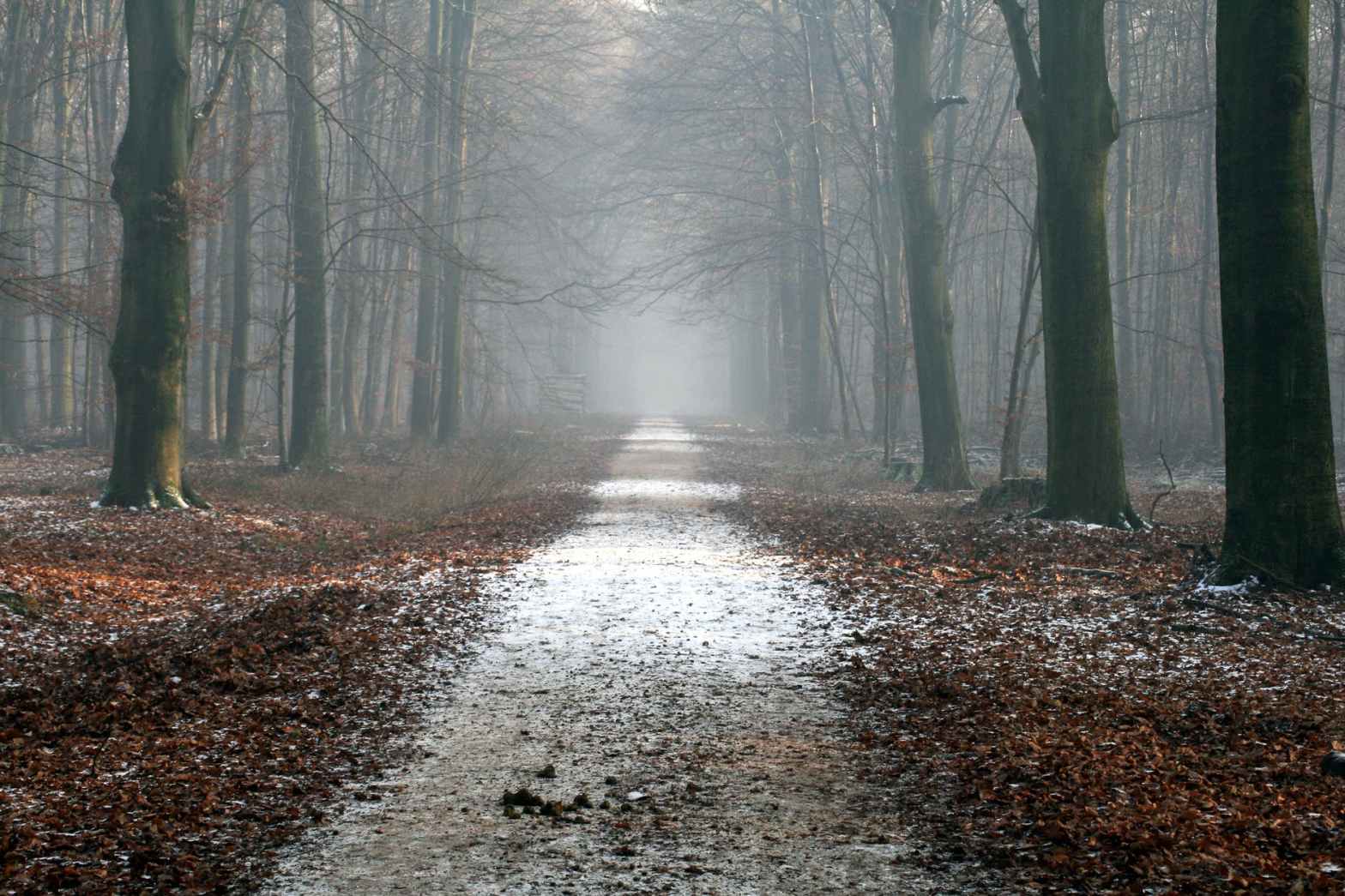
Today a fog has fallen on the grass. It reminds me of the way smoke would fill the house when I would burn something as I cooked dinner for my family as a child. Only today there is no burning, there is a coolness and a damp sorrow to the air and to the dark shapes of the trees, crooked sentinels gaurding ancient secrets.

Today I asked Finnigan (previously deceased) what it was like to return from the dead. A month ago he was shriveled and weeping, a yellow-white corpse of strings. Now he is green again by some miracle of biblical proportions, though no angel moved a stone for him. He did not answer me, unless silence itself was an answer, an expression of the void beneath the rich dark earth.

Today, a bird sat on a powerline outside a coffeshop that used to be a bank, which is now a coffeeshop that has no coffee and the bird sat and did not move, a dream inside the fog. Was he really there? I sat alone in the little shop and there was no coffee.

Today I lost my phone and my mother called and there was no answer for her.

Today I imagined what it would be like to be a fog like in the Carl Sandburg poem that goes like this: the fog comes on little cat feet it sits looking over harbor and city on silent haunches and then moves on.

It would be soft and quiet, like little cat feet. Little cat feet.

Today the rain in my hair is cold and so fine that I wonder if the prickling in my scalp is true moisture or only mind tricks. The mind plays tricks in the fog. As evening draws on it grows too dark to see but I feel the fog the way you can feel someone looking over your shoulder before you ever turn your head. In my imagination, the bird is still perched on the wire in the fog in the dark like a stone and Finn sends ghost white roots seeking through the soil where he died.

Today is tomorrow’s yesterday and someone’s birthday and someone else’s worst day and today is foggy but somewhere else is not today the dinner burned but that was not today it was another day but when it happened it was today, the day when anything happens is today and in the remembering it is happening again today, today a plant died but he got better today a seed was planted a tree uprooted somewhere today, today is today is

today

“Speak” Review

Laurie Halse Anderson’s novel “Speak” is a shocking narrative, and it is meant to be. The story follows a young girl, Melinda,  who is raped at a party and then ostracized by her peers for calling the cops. Over the course of the novel, she gains the courage to speak out about her experience when she realizes she has to protect other girls from going through what she did. 

Although the rape and overcoming her fear of revealing it is the major theme of the novel, there are some other things that are worth picking apart. Anderson also explores the importance of social groups and how far teenagers will go to find acceptance. Another underlying motif is the power of art to both give a voice to trauma and to aid in its healing. The book utilizes symbolism in a way that is very accessible even if the reader is not very familiar with how symbols are used in literature. 

The book might be useful in teaching symbolism if not for one thing–to my thinking, the content does not match the lexile level. This book is a very easy read at 690L, which puts it on level to be read by fifth graders. I am generally against censorship of ideas, but I also have to exercise good judgement. And I could not in good conscience hand a book about the rape of a fifteen year old girl to children aged 10-12. 

At the same time, as an education major and soon -to-be teacher, the thought of spending valuable classroom time with 9-10 graders (for whom the content is more appropriate and relevant) on a book four to five grades below their reading level physically pains me. I just do not think it would be a good use of time when it does not prepare them for the rigour of reading they will face on the state test. This week I saw a practice exam with a passage from Mark Twain’s “Life on the Mississippi,” a text I had difficulty chewing on in college. It would be a disservice to the kids to spend time on this instead of preparing them to comprehend heftier texts. 

This book is a classroom dilemma that makes me cringe because I think there’s an important message there to be told and that students in today’s world likely need to hear, but it’s like a dessert without a main dish. There’s plenty of theme and symbolism and imagery and all those favorite buzz words of English teachers for the kids to snack on, but there is no meat to back it up when it comes to comprehension.  I think there are other texts that could send the same message, while still challenging readers to reach their full potential. 

*Soapbox moment warning* SUCH AS, I DON’T KNOW, PERHAPS MAYA ANGELOU’S “I KNOW WHY THE CAGED BIRD SINGS” WHICH WAS RECENTLY BANNED IN THE DISTRICT I’M INTERNING AT EVEN THOUGH THE TEACHER OFFERED TO SKIP THE CHAPTER IN ANGELOU’S MEMOIR THAT IS DEEMED TOO EXPLICIT BECAUSE IT TALKS ABOUT HER RAPE AS A CHILD. THE SAME DISTRICT THAT ENCOURAGED TEACHERS TO DO UNITS ON THIS BOOK, WHICH ALSO DETAILS THE RAPE OF A MINOR….SORRY BUT THAT SOUNDS LIKE IT’S OK FOR A WHITE GIRL TO SPEAK OUT ABOUT TRAUMA BUT NOT OK FOR A BLACK WOMAN TO DO SO. THEY LITERALLY BANNED MAYA ANGELOU ON THE FIRST WEEK OF FEBRUARY, HAPPY BLACK HISTORY MONTH Y’ALL. *Soapbox descended*

I am sorry I have lots of feelings. They are not the fault of this book however. I would recommend this text on books of recommended reading for students in high school (not middle school) but would not devote classroom time to it unless a student wanted to talk about it. 

Design a site like this with WordPress.com
Get started